 +44 (0)1271 375197




-
Partners in product protection: Barum & Dewar and Astroscale
Expand ∨
Originally published 7 February 2024. Updated October 2026.
Barum & Dewar designed and manufactured a bespoke transit and storage container for Astroscale’s ELSA-M spacecraft, delivering the solution to the company’s Zeus facility at Harwell, Oxfordshire, in December 2023. Awarded in July 2023, the project marked B&D’s third contract with Astroscale and built on earlier work supporting the spacecraft’s development.
Supporting a more sustainable space sector
ELSA-M is an in-orbit demonstration mission intended to advance commercial end-of-life services for satellites equipped with a compatible docking interface. The demonstration will involve approaching, capturing and removing an inactive Eutelsat OneWeb satellite, supporting the development of services that help operators manage spacecraft responsibly at the end of their operational lives.
The mission is majority funded by Astroscale, with co-funding support from the UK Space Agency through the European Space Agency’s Sunrise Partnership Project with Eutelsat.
Since B&D delivered the container, the spacecraft programme has continued through development and testing. Astroscale selected Isar Aerospace as its launch provider in March 2026, with ELSA-M scheduled to travel aboard the company’s Spectrum rocket. Astroscale’s October 2026 update reported that the spacecraft had been delivered to RAL Space for electromagnetic compatibility testing and identified a planned launch in its financial year ending April 2028.
Protection designed around the spacecraft
B&D had previously supplied a DELTA®-style container for the structural qualification model. For the mission spacecraft, the team developed a fully fabricated, environmentally sealed solution incorporating a shock-mounted platform, purge and rapid decompression capability, and dual-height lids to accommodate different payload configurations.
The container was designed to provide a secure, clean and dry environment during domestic and international transportation, protecting the spacecraft against shock, vibration and ground-handling movements.
Developing this type of solution requires consideration of both the hardware and the practical demands of moving it. Payload interfaces, environmental protection, access and handling arrangements all influence how the container needs to perform throughout the programme.
A partnership built through successive projects
Carlotta Morini, Project Director, said, “We’re delighted to be working with Barum & Dewar again on this third contract. It is fantastic to have such a strong supply chain as the ELSA-M mission continues to grow and pave the way for commercial in-orbiting practises to become routine to ensure our orbits stay safe and sustainable for future generations.”
The project demonstrates B&D’s collaborative approach to engineered protection, bringing customer requirements and specialist container expertise together to support complex space hardware.
To discuss protective packaging for flight hardware, ground support equipment or specialist components, contact the B&D team.
-
Scotland’s space success is built on more than satellites
Expand ∨
A recent BBC feature has put the spotlight on Glasgow’s remarkable development as a centre for small satellite manufacturing, and the opportunity now facing Scotland as competition and investment in the European space sector continue to increase.
For Barum & Dewar, it is a story that feels particularly close to home. With our roots in Scotland and more than 25 years working with businesses across the global space sector, we have seen first-hand how Scotland’s capabilities have developed and how a wider network of specialist businesses has grown around them.
Glasgow is now recognised as a European leader in small satellite manufacturing. Companies including AAC Clyde Space have played an important role in that development, helping establish an industry that combines engineering expertise, research, technology and an increasingly experienced supply chain.
B&D is proud to have supported businesses within this ecosystem, including AAC Clyde Space, while our involvement in the sector extends across the UK and internationally. We design and supply protective packaging for flight hardware and ground support equipment, with solutions ranging from smaller specialist cases through to large bespoke containers designed around complex and highly valuable payloads.
That experience has also shown us that a successful space industry depends on much more than the spacecraft itself.
Behind every satellite, component or propulsion system is a network of organisations responsible for designing, manufacturing, testing, handling, transporting and protecting that equipment. Each has its own role in ensuring hardware reaches the next stage of its journey in the condition required.
For protective packaging, that can mean understanding far more than the dimensions and weight of a piece of equipment. How will it be handled? How many times will it travel? What environmental conditions could it encounter? Does it need protection from shock, vibration, moisture or contamination? How will operators access it, inspect it or remove it from its container? What happens to the packaging after the first journey?
These considerations become particularly important in the space sector, where equipment can represent years of development and significant investment, and where there is little margin for error.
B&D’s approach is therefore to work closely with customers from the outset, understanding the complete journey of the equipment before developing the protective solution around it. Our cases and containers have travelled to launch sites around the world, with some undertaking multiple missions and being refurbished or reconfigured for future use.
As Scotland looks to build on its success in space, maintaining the depth of capability around its manufacturers will be important. The strength of the sector lies not only in the businesses designing and building spacecraft, but in the engineering, technology, research and specialist supply-chain expertise that allows them to operate successfully on an international stage.
Having joined Space Scotland in 2022, B&D is proud to be part of that community and to contribute specialist expertise developed through more than two decades supporting demanding space programmes.
The story of Scotland’s growing space sector is rightly attracting attention. The opportunity now is to continue strengthening the complete ecosystem behind it, ensuring that the expertise developed here can support the next generation of missions from Scotland, the UK and around the world.
-
Why complex equipment needs more than standard protective packaging
Expand ∨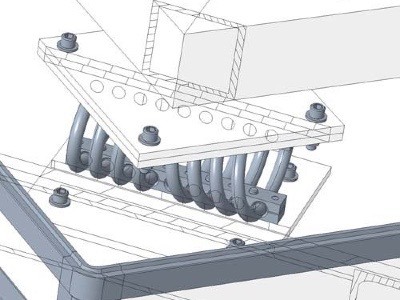
Standard protective packaging has a useful role in many applications, particularly where the product is relatively straightforward, the route to market is predictable and the risks are well understood. However, complex equipment often brings together a very different set of requirements, where size, value, sensitivity, handling, access and operational readiness all need to be considered at the same time. In these cases, the packaging has to do more than contain the equipment; it has to form part of the wider protection and handling strategy.
For customers working in defence, space, aerospace, offshore and technical industrial markets, the equipment being transported may often be fragile, heavy, awkwardly balanced or mission critical (and occasionally all). It may be moving between manufacturing sites, test facilities, launch locations, vessels, operational bases or end-user environments. Each stage introduces potential risk, from vibration and shock to moisture, contamination, poor handling, movement in transit or damage during loading and unloading.
This is why standard packaging is not always enough. A rugged case may provide a strong outer shell, but the wider design still has to address how the equipment is restrained, cushioned, accessed, lifted and protected throughout its journey. For some projects, that may mean engineered foam inserts; for others it may require fabricated aluminium containers, interface plates, wire shock mounts, handling frames, trolleys, purge fittings, humidity indicators or a combination of several of these elements.
B&D’s own work reflects this need for more considered solutions. The business undertakes projects ranging from cases with foam to large-scale fabricated transit containers, demonstrating the breadth of requirements that can sit within specialist protective packaging. Its bespoke fabrication capability also extends to containers and handling equipment for demanding sectors, where solutions may need to account for shock attenuation, environmental protection, cleanliness, payload interfaces and operational use.
The difference is that complex equipment is rarely protected properly through one decision alone. It requires a series of connected design choices, each one shaped by the asset and the conditions it will face. The outer case or container matters, but so does the internal support system, the material selection, the way the equipment is loaded, the available clearance, the restraint method, the labelling and the long-term serviceability of the packaging.
When equipment is valuable, sensitive or operationally important, protective packaging should not be treated as an afterthought. It is part of protecting the customer’s investment, maintaining schedules and ensuring it arrives ready for use.
-
How B&D moves from brief to engineered solution
Expand ∨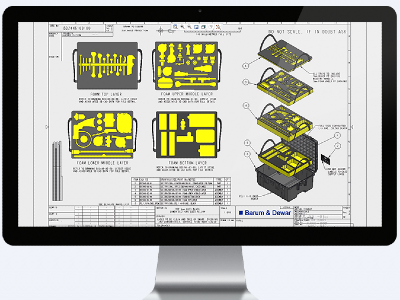
Protective packaging for high-value equipment is rarely a matter of selecting a case and adjusting the internal fit. For Barum & Dewar, the process begins much earlier, with a detailed understanding of the equipment, the environment it will move through and the practical requirements of the people responsible for handling it. The brief is not treated as a narrow set of dimensions, but as the start of an engineering process that considers protection, usability, transport, storage, deployment and long-term value.
This early stage is important because many of the products B&D protects are not straightforward to package. They may be sensitive to shock or vibration, awkward to lift, unusually shaped, high in value or critical to the customer’s wider operation. In defence, space, aerospace, offshore and industrial environments, packaging has to perform in real conditions, often across multiple handling points and modes of transport. B&D’s partnership approach is based on understanding transportation, handling and user requirements before developing the most appropriate solution, drawing on both in-house design capability and established supply partnerships.
Once the requirement is understood, the design process moves into more detailed technical definition. Where CAD data is available, it can be used to help model the equipment and create a virtual representation of the proposed solution. This allows the team to assess how the payload will sit within the case or container, where support points are needed, how internal components should be arranged and whether there are any issues around access, clearance, loading or removal. It also gives the customer a clearer view of the proposed solution before manufacture begins, reducing uncertainty and allowing feedback to be incorporated at the right stage.
For sensitive equipment, the engineering considerations may go further. B&D has access to shock analysis software that can help calculate suitable protection against shock and vibration inputs, including the use of wire shock mounts or calculated foam thicknesses depending on the nature of the payload and the selected drop height. These calculations help define how the packaging system should perform, rather than relying on assumption or generic protection levels.
The design then becomes the basis for manufacture. Any machined part, from foam to spacecraft interface plates are CNC machined from the B&D approved and controlled data, allowing verification at part and assembly level as the project progresses. This connection between brief, design and manufacture is central to B&D’s approach. The aim is not simply to make packaging that fits around a product, but to develop a solution that protects it, supports safe and practical use, and gives the customer confidence that the equipment can be moved, stored and deployed as intended. From a simple foam insert to a large fabricated container, the same principle applies: the strongest solutions are built from a clear understanding of the challenge.
-
David Frame: A tribute from the Barum & Dewar Team
Expand ∨
Over the past few weeks, we have taken time as a team to reflect on the loss of David and the enormous impact he had on Barum & Dewar and on the people around him.
David was immensely proud of this business. He cared deeply about the work we delivered, the relationships we built and the reputation Barum & Dewar earned over many years. He believed strongly in doing things properly, supporting customers when it mattered and building a business founded on trust, integrity and respect.
For those of us fortunate enough to work alongside him, David was far more than a Managing Director. He was a mentor, a sounding board, a leader and above all, an incredibly kind and supportive person.
Many of the conversations we have shared as a team since his passing have centred not only on what David achieved professionally, but on the way he made people feel. He always made time for others. He encouraged people to back themselves, to show courage, to be fearless and to approach situations with honesty and kindness.
David led by example. He worked tirelessly for the business and for the people within it, always holding himself to the highest standards. His positivity, calmness and generosity left a lasting impression on everyone who had the privilege of knowing him.
Across the team and from former colleagues, there is a huge sense of gratitude for the opportunity to have worked with David and learned from him. We know many of our customers, suppliers and industry contacts will feel the same. He built strong and lasting relationships throughout his career and was respected not only for his knowledge and leadership, but for being genuine, personable and dependable.
While the past weeks have been incredibly difficult, they have also reinforced just how much David meant to this business and to the people within it. The values he championed continue to shape Barum & Dewar every day and remain deeply embedded within the team he helped build.
We remain incredibly proud to have worked alongside him and grateful for everything he gave to the business and to all of us personally.
Our thoughts continue to be with David’s family and friends.