 +44 (0)1271 375197


How B&D moves from brief to engineered solution
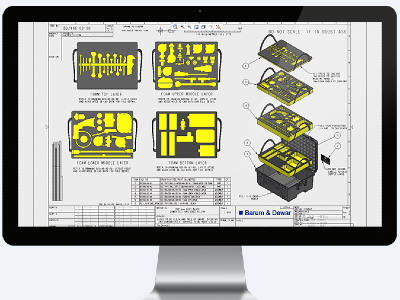
Protective packaging for high-value equipment is rarely a matter of selecting a case and adjusting the internal fit. For Barum & Dewar, the process begins much earlier, with a detailed understanding of the equipment, the environment it will move through and the practical requirements of the people responsible for handling it. The brief is not treated as a narrow set of dimensions, but as the start of an engineering process that considers protection, usability, transport, storage, deployment and long-term value.
This early stage is important because many of the products B&D protects are not straightforward to package. They may be sensitive to shock or vibration, awkward to lift, unusually shaped, high in value or critical to the customer’s wider operation. In defence, space, aerospace, offshore and industrial environments, packaging has to perform in real conditions, often across multiple handling points and modes of transport. B&D’s partnership approach is based on understanding transportation, handling and user requirements before developing the most appropriate solution, drawing on both in-house design capability and established supply partnerships.
Once the requirement is understood, the design process moves into more detailed technical definition. Where CAD data is available, it can be used to help model the equipment and create a virtual representation of the proposed solution. This allows the team to assess how the payload will sit within the case or container, where support points are needed, how internal components should be arranged and whether there are any issues around access, clearance, loading or removal. It also gives the customer a clearer view of the proposed solution before manufacture begins, reducing uncertainty and allowing feedback to be incorporated at the right stage.
For sensitive equipment, the engineering considerations may go further. B&D has access to shock analysis software that can help calculate suitable protection against shock and vibration inputs, including the use of wire shock mounts or calculated foam thicknesses depending on the nature of the payload and the selected drop height. These calculations help define how the packaging system should perform, rather than relying on assumption or generic protection levels.
The design then becomes the basis for manufacture. Any machined part, from foam to spacecraft interface plates are CNC machined from the B&D approved and controlled data, allowing verification at part and assembly level as the project progresses. This connection between brief, design and manufacture is central to B&D’s approach. The aim is not simply to make packaging that fits around a product, but to develop a solution that protects it, supports safe and practical use, and gives the customer confidence that the equipment can be moved, stored and deployed as intended. From a simple foam insert to a large fabricated container, the same principle applies: the strongest solutions are built from a clear understanding of the challenge.